Forum Replies Created
-
AuthorPosts
-

I believe this was the first Baum designed house in greater Riverdale- his own, in 1914.
Thanks so much for sharing Dale.
The historical details matter.
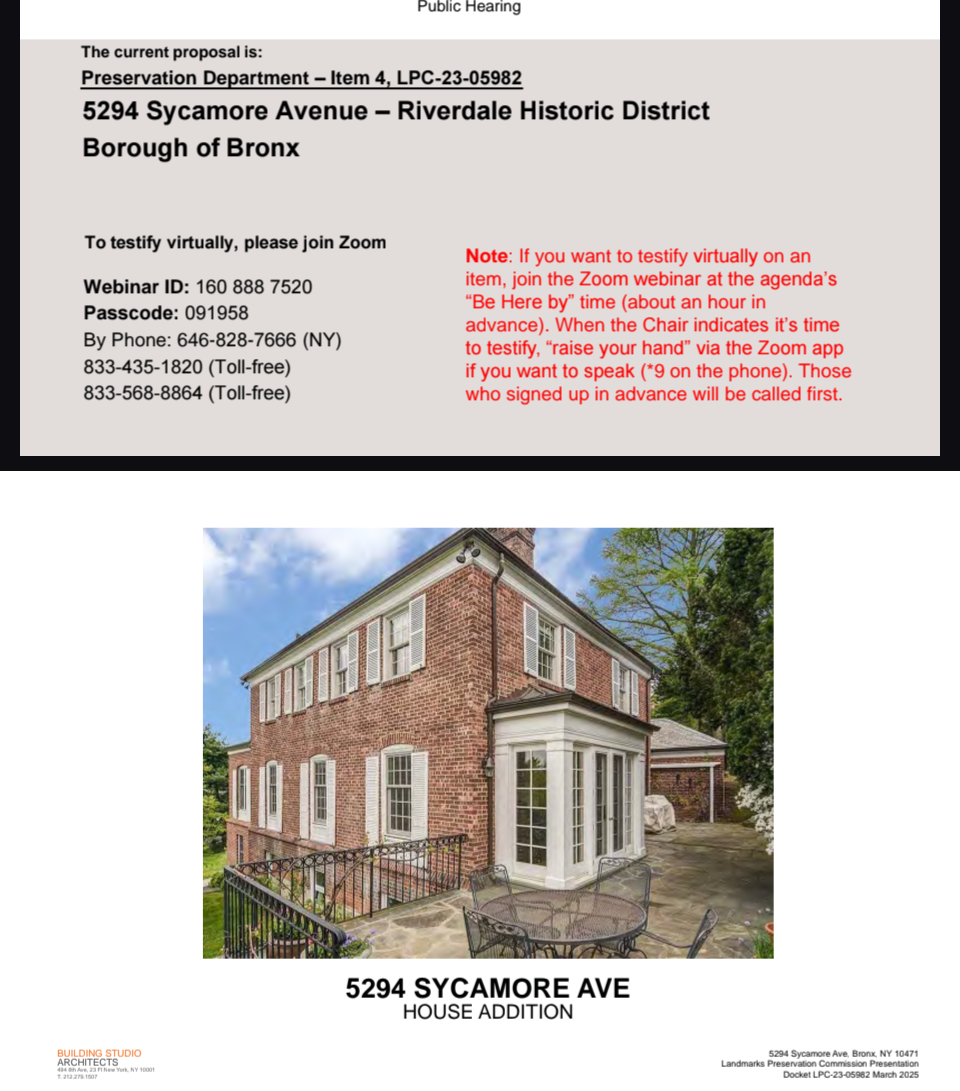
It is indeed. And in the Riverdale Historic District.
There was a LPC hearing on an addition to the structure, but I don’t know what decision LPC made
Are you familiar with “Riverdale Heights” homes? Are there any Dwight James Baum homes in your neighborhood?
What do you know about them?Lets keep the ball rolling and share what we know about these homes that are so iconic in our community!
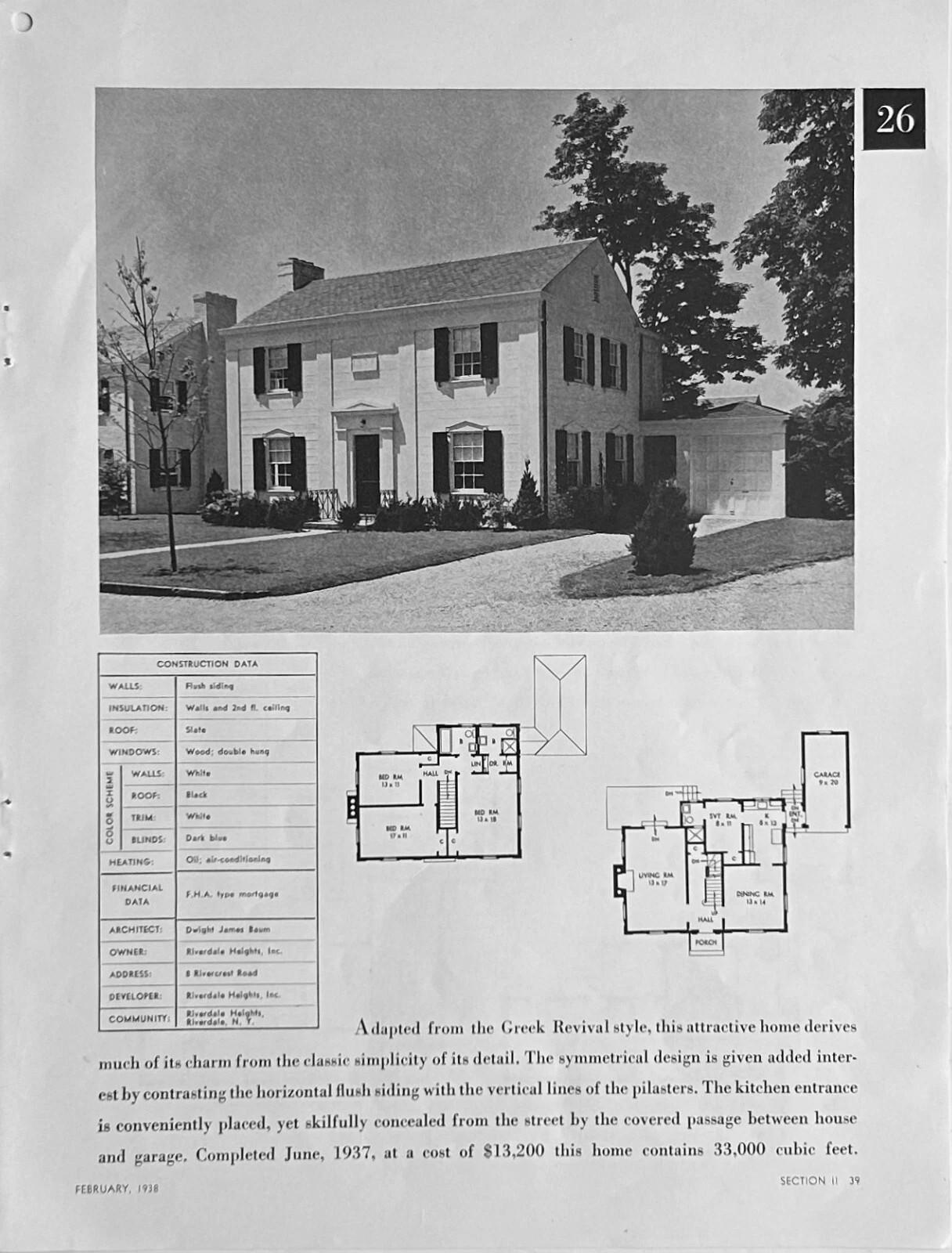
from 1938, an Architectural listing of a Riverdale Heights home.
Mr. Jensen asked if any of these homes still stood, with black English tile from the Ludowici tile company.
I found a few real estate listings, several of which mention that Dwight James Baum was the architect.
5 Rivercrest Road
A rare gem in Riverdale, West of the Parkway on a private cul de sac. This classic center hall colonial tucked away in the estate section is set on beautifully landscaped property close to the Hudson river and a short walk to the Riverdale Metro-North station. Designed by noted architect, Dwight James Baum, it is one of a special enclave of homes in Riverdale Heights. sothebysrealty.com/…/5-rivercrest-road-bronx-ny-10471
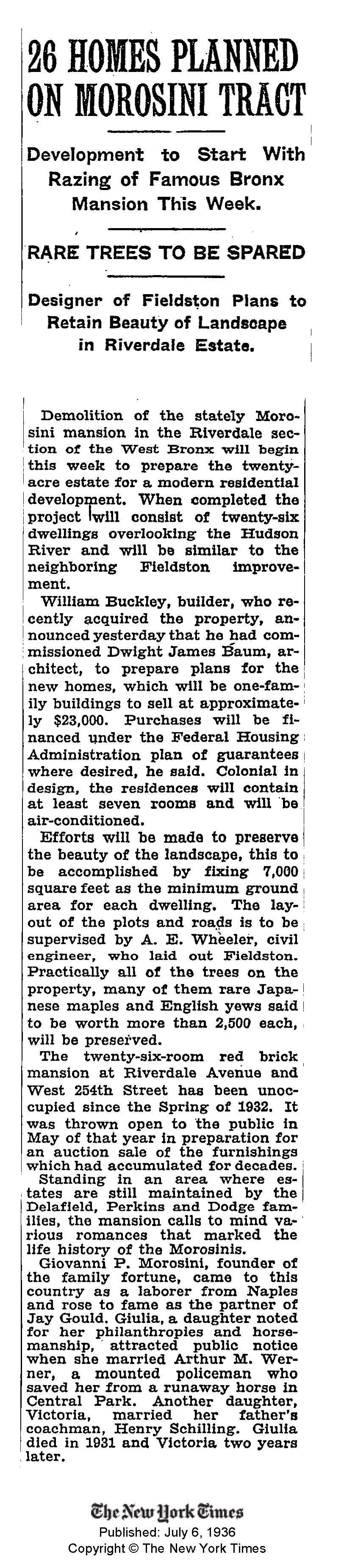
In 1937, a NY TIMES article cited Dwight James Baum as the architect of the development “Riverdale Heights”, replacing the remarkable Elmhurst with the more modest but lovely homes that still grace Rivercrest road and 254th street in the NW section of Riverdale, north of Wave Hill.
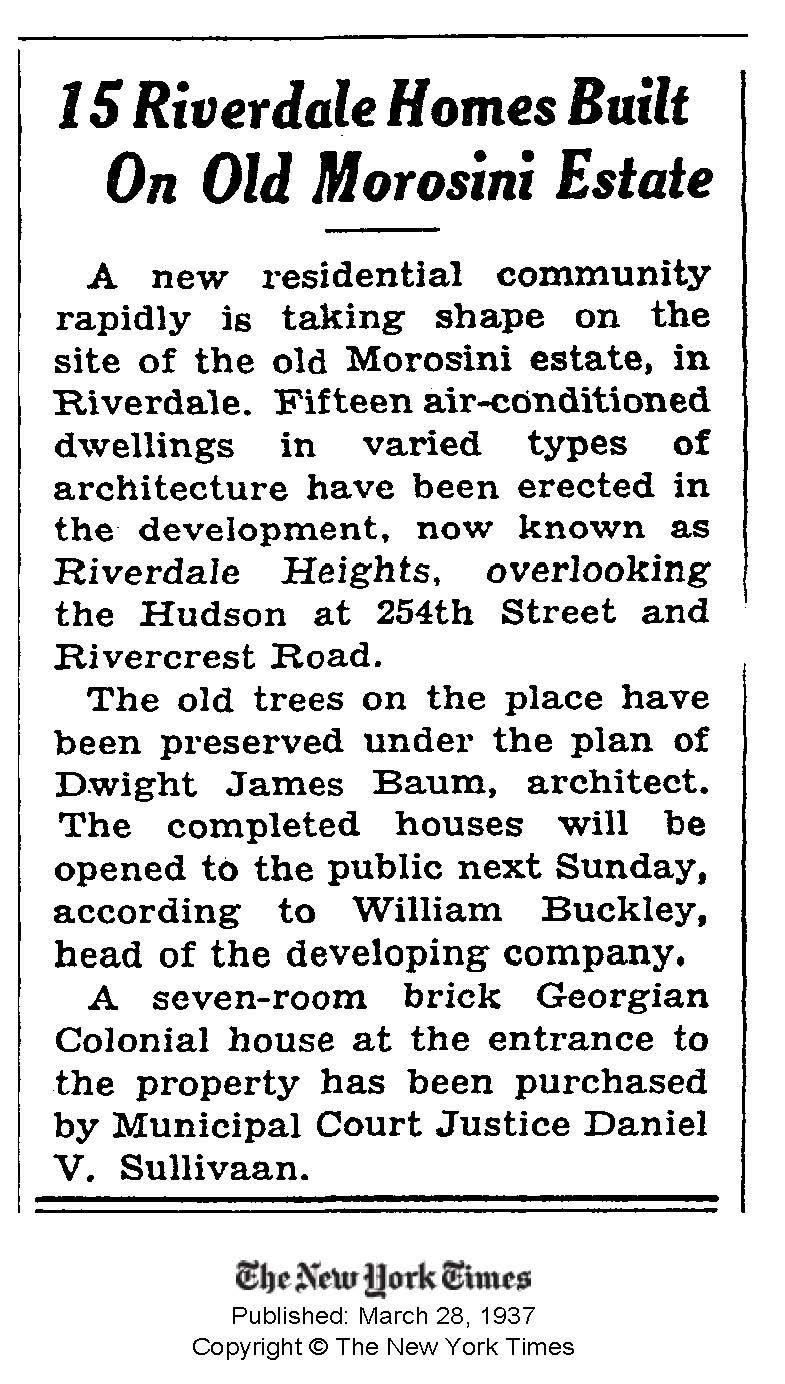
Elmhurst was by all definition a remarkable home (perhaps more about that in a separate post), but after the deaths of Mr. Morosini’s children, it stood unoccupied until 1932.
In 1936, demolition of the mansion began to prepare the tract for a modern residential development.
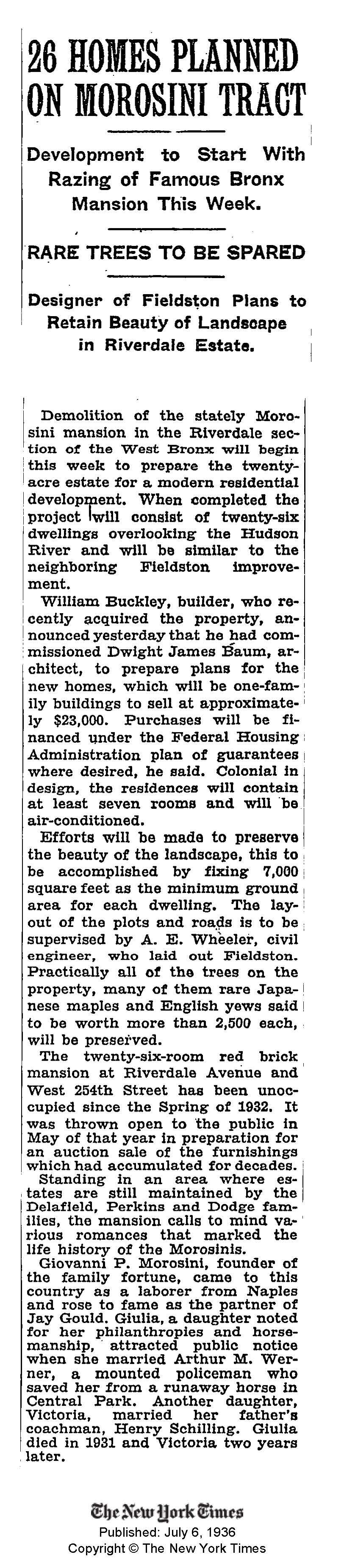
Financier and banker, Giovanni Morosini was born in Venice, Italy in 1832, when Italy was still a part of the Austrian empire During the revolt against Austrian supremacy in 1848, he joined the patriot forces. He fled the country, and once in New York City, he worked in Garibaldi’s candle factory. One night along the waterfront he saved a boy being beaten by a gang of youths. The boy was the son of Nathaniel Marsch, Secretary of the Erie Railroad. Marsch gave him a job as an office boy with the Erie Company on May 25, 1855. Morosini learned bookkeeping, and eventually was appointed General Auditor. He met Jay Gould in 1868, and sided with him during the fight for control of the company. Morosini became Gould’s confidential secretary. He amassed a fortune worth several millions, and a vast art and coin collection. There is a Giovanni P. Collection at the Metropolitan Museum of Art.
His home in Riverdale was a rambling Victorian called “Elmhurst”, and was filled with valuable furnishings and art. He also built an armory near his house which was filled with all sorts of ancient weaponry. His stable was considered one of the best in Riverdale. He died in 1908.

Although we all go by the shorthand of calling our community “Riverdale”, we know that it is actually several neighborhoods. (Riverdale, Spuyten Duyvil, Fieldston, etc.)
So when someone tells me they are looking for something in Riverdale, I know I have to ask for a little more information. There are Baum designed houses in various neighborhoods in Riverdale-at-Large.
But the most important fact that I needed was the date and date range. This particular development was completed around 1937. And the NY Times had a few articles on it, which apparently was on the property of the former Morosini Estate.
For those of you who might not be familiar, Dwight James Baum was a famous architect in the first part of the 20th century, who lived in Riverdale. His biography from the Lehman College web pages on Bronx architecture:
Dwight James Baum
(b. 1886, d. 1939)Distantly related to L. Frank Baum who wrote the Wizard of Oz, Dwight James Baum was born near Newville, New York. He attended Syracuse University to study architecture and graduated in 1909, winning the school’s Architectural Fellowship. Baum worked for several architectural firms in New York City including Boring and Tilton; Kirby, Petit and Green; Sanford White; and finally Frank M. Andrews. In about 1912, Baum purchased a lot in the Riverdale area of the West Bronx where he built a Dutch Colonial style home for himself. He eventually resigned from the Andrews firm and devoted all his efforts to his own designs. From 1914 to 1939, Baum designed 140 houses in the Riverdale area, primarily Tudor and Greek Revival styles. His design for Dr. Francis Collins won the Better Homes in American Gold Medal in 1931 for the best two-story house constructed between 1926 and 1930. In addition to these residential works, Baum also designed the Riverdale Country Club (1917) and the Arrowhead Inn, a restaurant in Riverdale (1924).
In 1922 Baum received the most important residential commission of his career from John and Mabel Ringling. John Ringling was best known as one of the Ringling Brothers of Ringling, Barnum and Bailey Circus. This building is now part of the Ringling Museum of Art in Sarasota, Florida. Baum worked in Florida and designed the Sarasota County Courthouse, the Sarasota Times Building and the First Presbyterian Church. He was credited by American Architect magazine (October, 1926) with developing a new Mediterranean Revival style through his work in the area.
During the depression, Baum developed a close association with the Architectural League of New York. From the early 1920’s Baum had been active in preservation activities. Among the projects undertaken at this time by Baum’s office was the research and documentation of historic buildings in Barrytown, New York and Charleston, South Carolina. Two of Baum’s most noteworthy designs during the Depression were the West Side YMCA in New York City (at 5 West 63rd Street), and the Federal Building in Flushing, New York. It was during the Depression that Baum made his major contributions to the architecture of his alma mater, Syracuse University.
Baum’s designs can be found the entire length of the eastern seaboard including New England, New York, New Jersey, the Carolinas and Florida.
https://www.lehman.edu/vpadvance/artgallery/arch/bio/baum.html
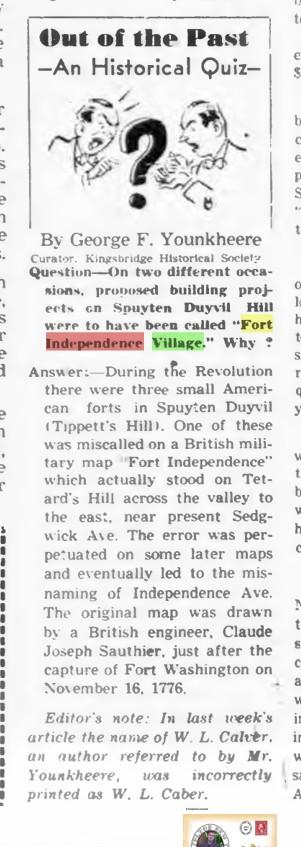
“By George F. Younkheere
Curator. Kingsbridge Historical Society
Question—On two different occasions. proposed building projects on Spuyten Duyvil Hill were to have been called “Fort
Independence Village.” Why ?Answer:—During the Revolution there were three small American in Spuyten Duyvil
(Tippett’s Hill). One of these was miscalled on a British military map Fort Independence”
which actually stood on Tetard’s Hill across the valley to the east, near present Sedgwick Ave. The error was
perpetuated on some later maps and eventually led to the misnaming of Independence Ave.
The original map was drawn by a British engineer, Claude Joseph Sauthier, just after the
capture of Fort Washington on November 16, 1776”What happened to the “Fort Independence Village”?
We know what ultimately happened to the Berrian Homestead. But why didn’t this very ambitious project take place, at least not in the way, and to the extent it had been forecast?
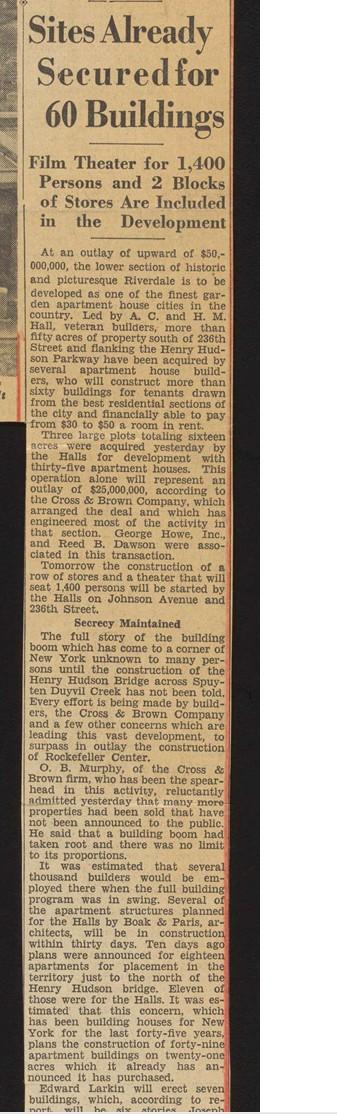 1937 Article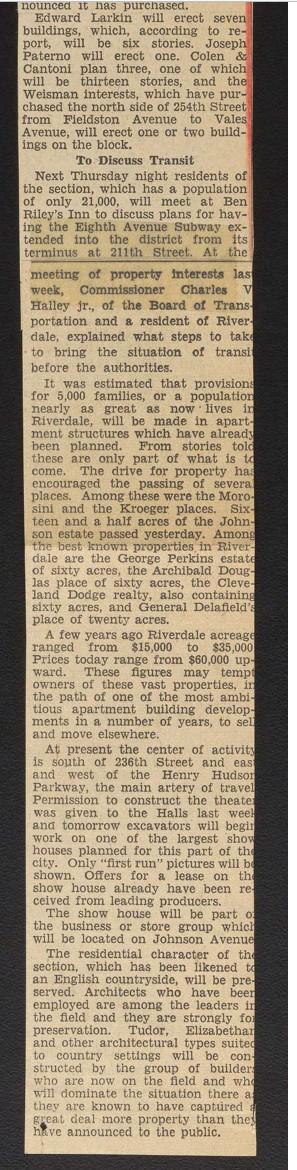
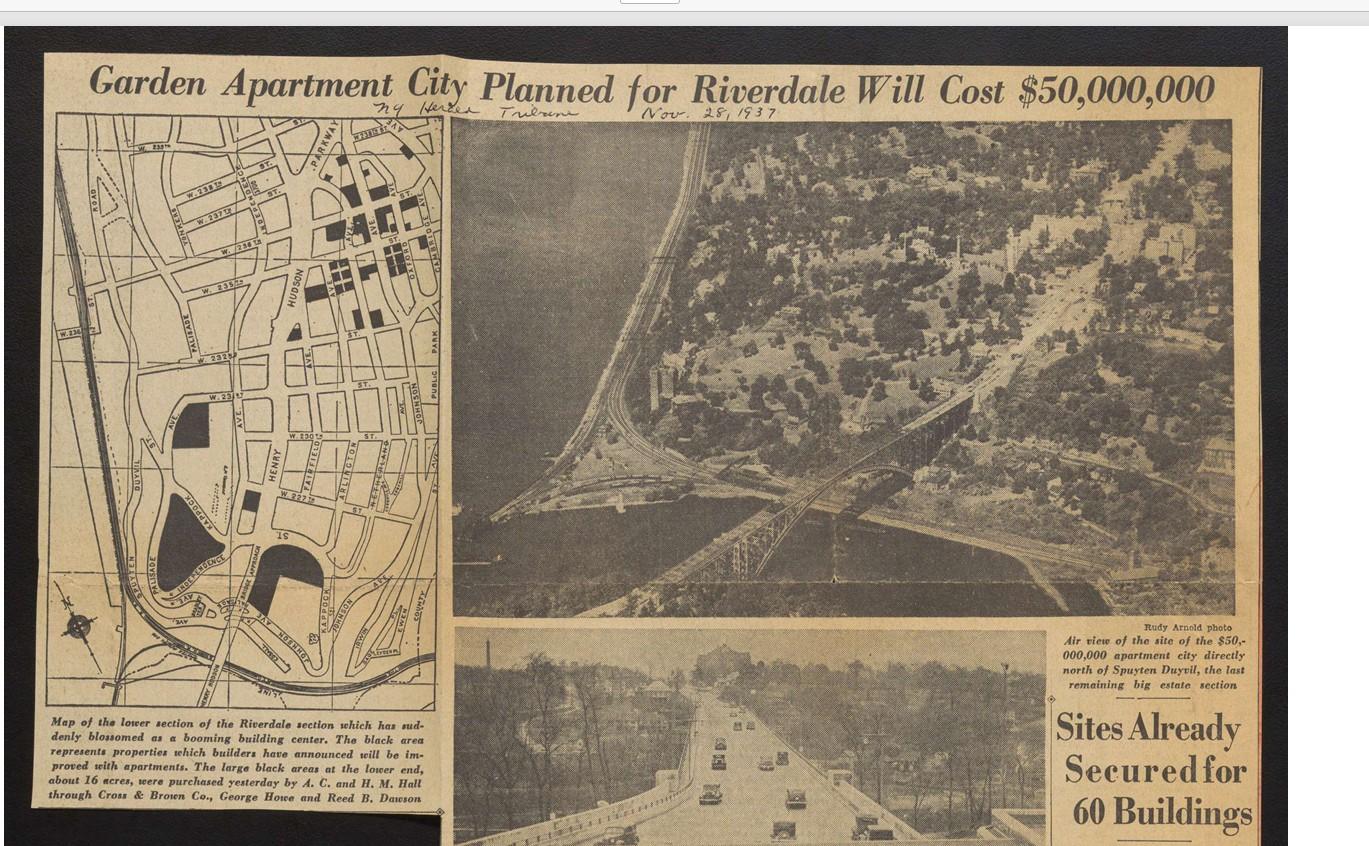
Here is an earlier article from 1937 outlining development of the Spuyten Duyvil area and also the area now known as Central Riverdale.
I think that we should petition our Elected Officials to revise Landmarks regulations to be more flexible and productive.
Riverdale is a perfect example nof how Landmarks regulations backfire instead of encouraging preservation.
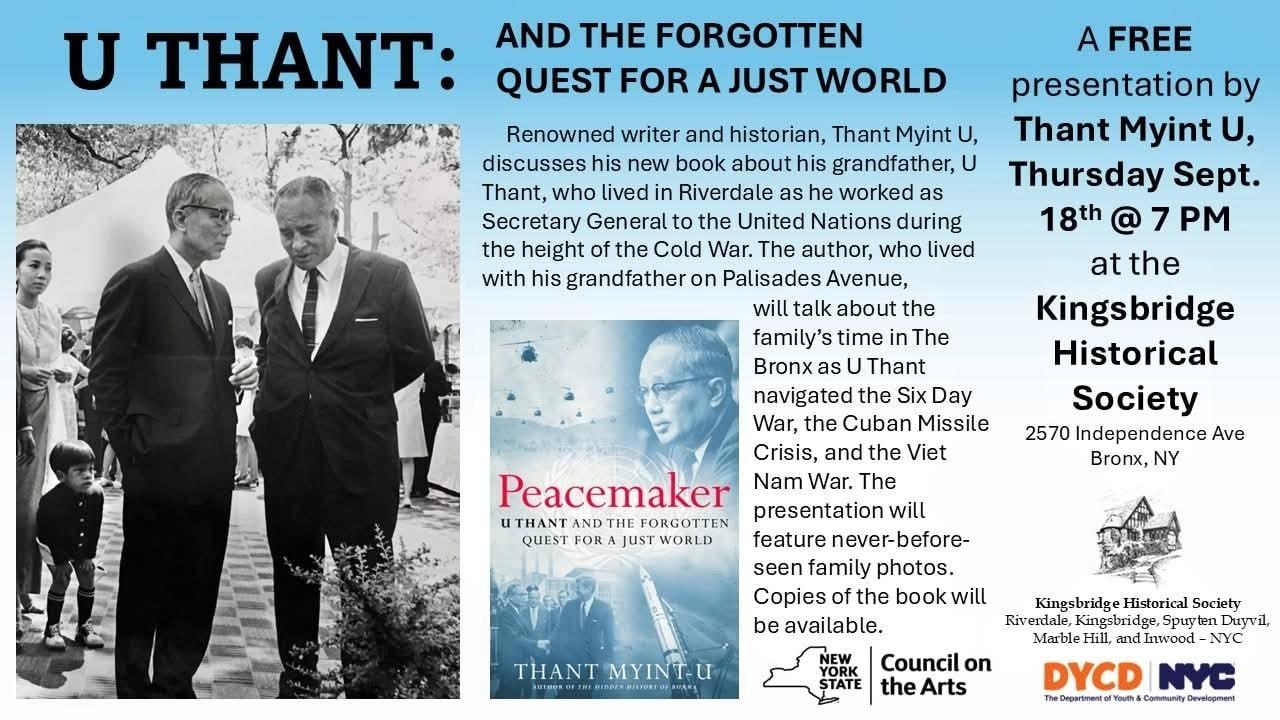
Join us on September 18 to learn more about the legacy of third Secretary General U Thant who lived with his family at the property now known as “Raoul Wallenberg Forest” during the years 1961 through 1971.
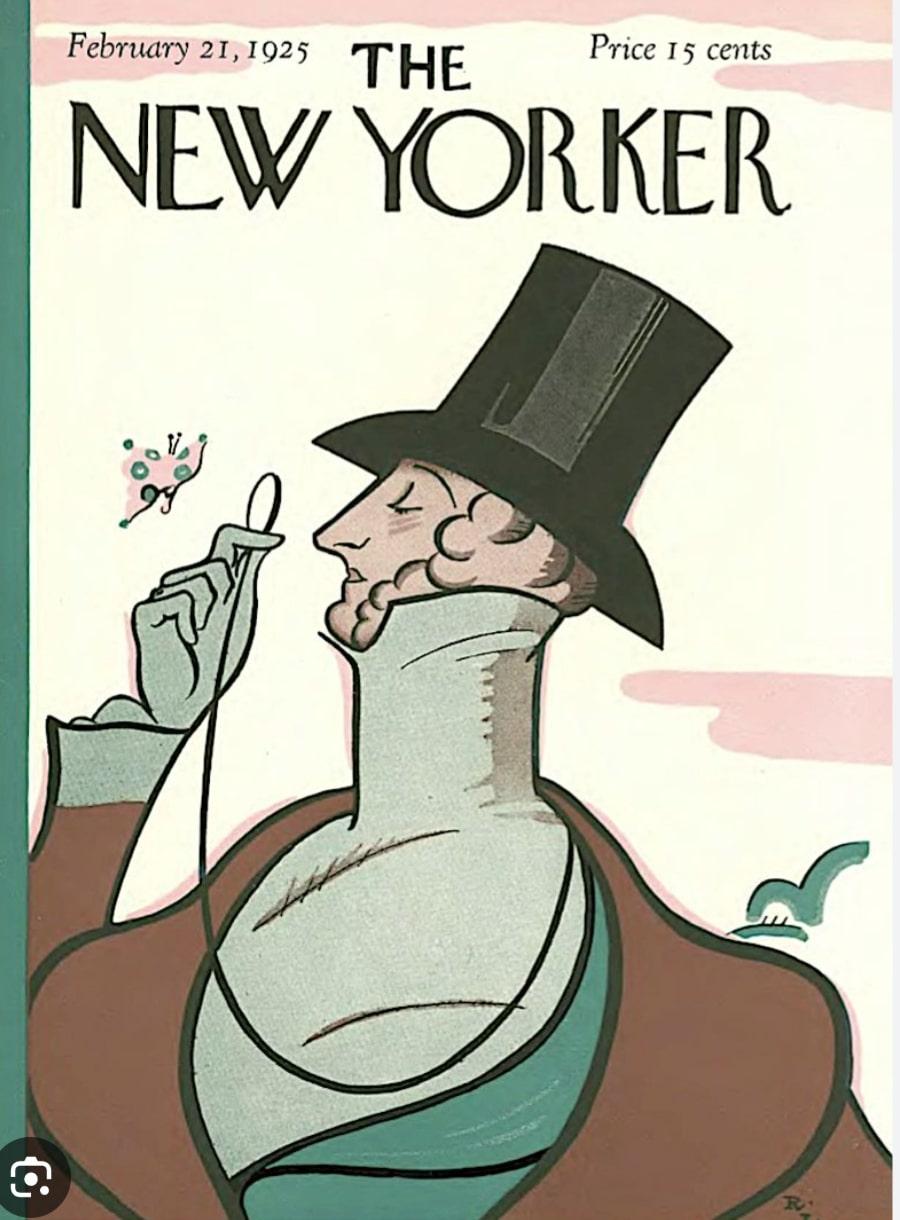
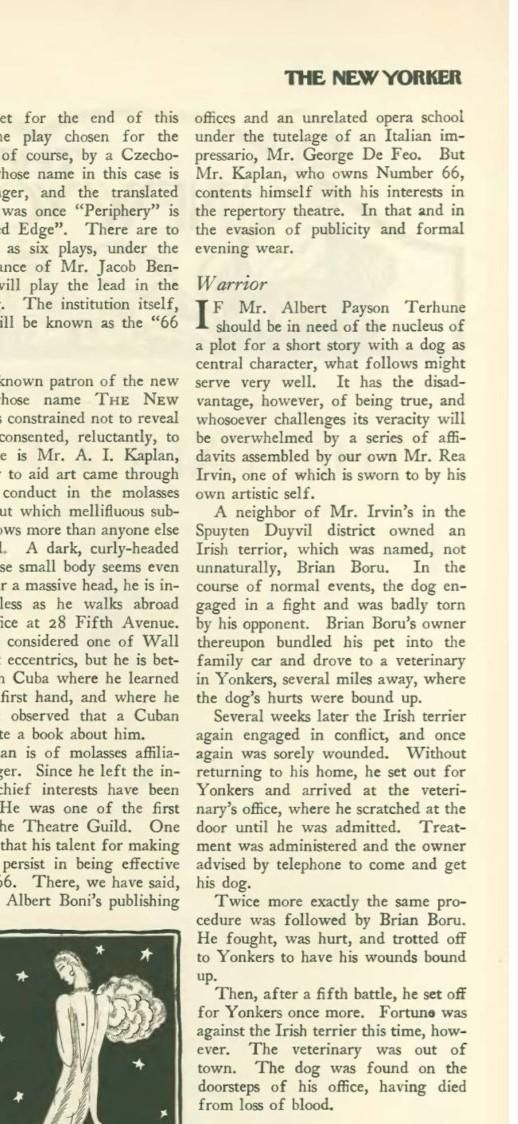
A not politically correct story concerning Rhea Irvin in Spuyten Duyvil, and a fight between his and a neighbors dog took place in 1925, which means the 1930 property was not his primary home, or at least not originally.
The story is sad, but shows us how animals about pets have changed in the 100 years since this occurred.
As yet the “nuclear physicist” was (more research to be done), but Mr. Henry H. Wells, lived at
lived at 777 Kappock until 1978.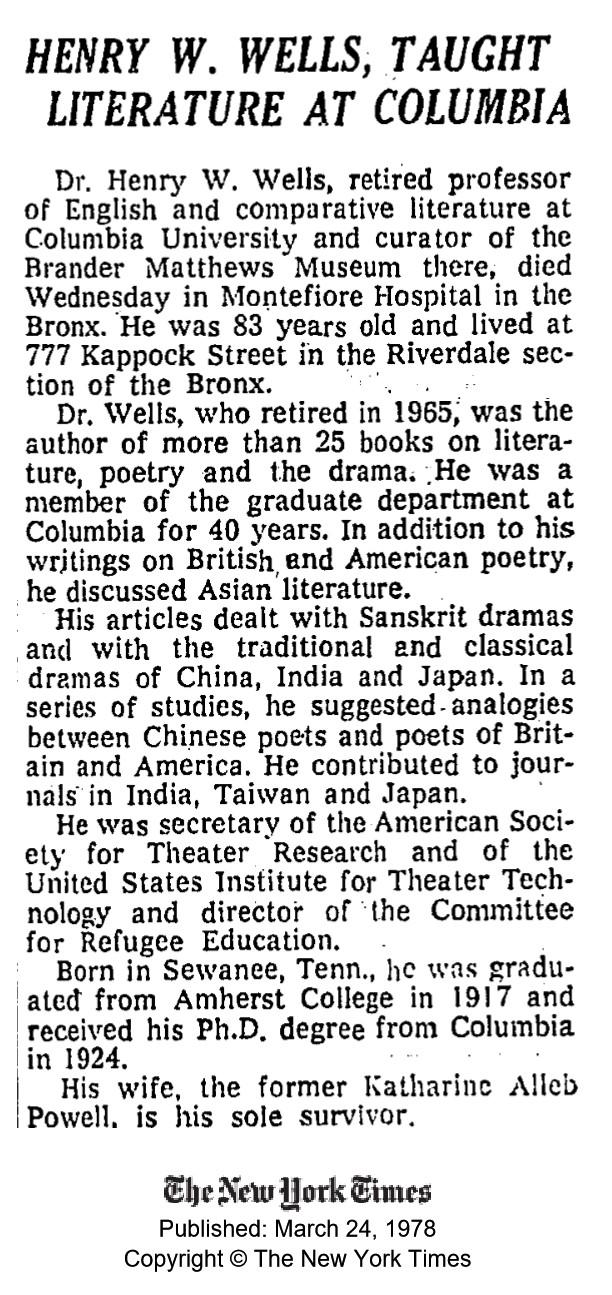
”
HENRY W. WELLS, TAUGHT LITERATURE AT COLUMBIA
Dr. Henry W. Wells, retired professor of English and comparative literature at Columbia University and curator of the Brander Matthews Museum there, died Wednesday in Montefiore Hospital in the Bronx. He was 83 years old and lived at 777 Kappock Street in the Riverdale section of the Bronx.
Dr. Wells, who retired in 1965; was the author of more than 25 books on literature, poetry and the drama. He was member of the graduate department at Columbia for 40 years. In addition to his writings on British and American poetry, he discussed Asian literature.
His articles dealt with Sanskrit dramas and with the traditional and classical dramas of China, India and Japan. In series of studies, he suggested- analogies between Chinese poets and poets of Britain and America. He contributed to journals in India, Taiwan and Japan.
He was secretary of the American Society for Theater Research and of the United States Institute for Theater Technology and director of the Committee for Refugee Education.”
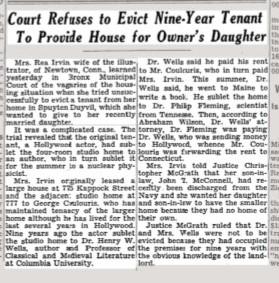
And this is kind of fun: an article about a court fight about a property owned by the Irvin’s that they rented to a famous Hollywood Actor George Alexander Coulouris (1 October 1903 – 25 April 1989). He was an English film and stage actor. He was perhaps best known for his collaborations with Orson Welles, most notably Citizen Kane.
“Court Refuses to Evict Nine-Year Tenant To Provide House for Owner’s Daughter
Mrs. Rea Irvin, wife of the illustrator, of Newtown, Conn., learned yesterday in Bronx Municipal Court of the vagaries of the housing situation when she tried unsuccessfully to evict a tenant from her home in Spuyten Duyvil, which she wanted to give to her recently married daughter.
It was a complicated case. The trial revealed that the original tenant, a Hollywood actor, had sublet the four-room studio home to an author, who in turn sublet it for the summer to a nuclear physicist.
Mrs. Irvin originally leased a large house at 775 Kappock Street and the adjacent studio home at 777 to George Coulouris, who has maintained tenancy of the larger home although he has lived for the last several years in Hollywood. Nine years ago the actor sublet the studio home to Dr. Henry W. Wells, author and Professor of Classical and Medieval Literature at Columbia University.
Dr. Wells said he paid his rent to Mr. Coulouris, who in turn paid Mrs. Irvin. This summer, Dr. Wells said, he went to Maine to write a book. He sublet the home to Dr. Philip Fleming, scientist from Tennesse. Then, according to Abraham Wilson, Dr. Wells’ attorney, Dr. Fleming was paying Dr. Wells, who was sending money to Hollywood, whence Mr. Coulouris was forwarding the rent to Connecticut.
Mrs. Irvin told Justice Christopher McGrath that her son-in-law, John T. McConnell, had recently been discharged from the Navy and she wanted her daughter and son-in-law to have the smaller home because they had no home of their own.
Justice McGrath ruled that Dr. and Mrs. Wells were not to be evicted because they had occupied the premises for nine years with the obvious knowledge of the landlord.”
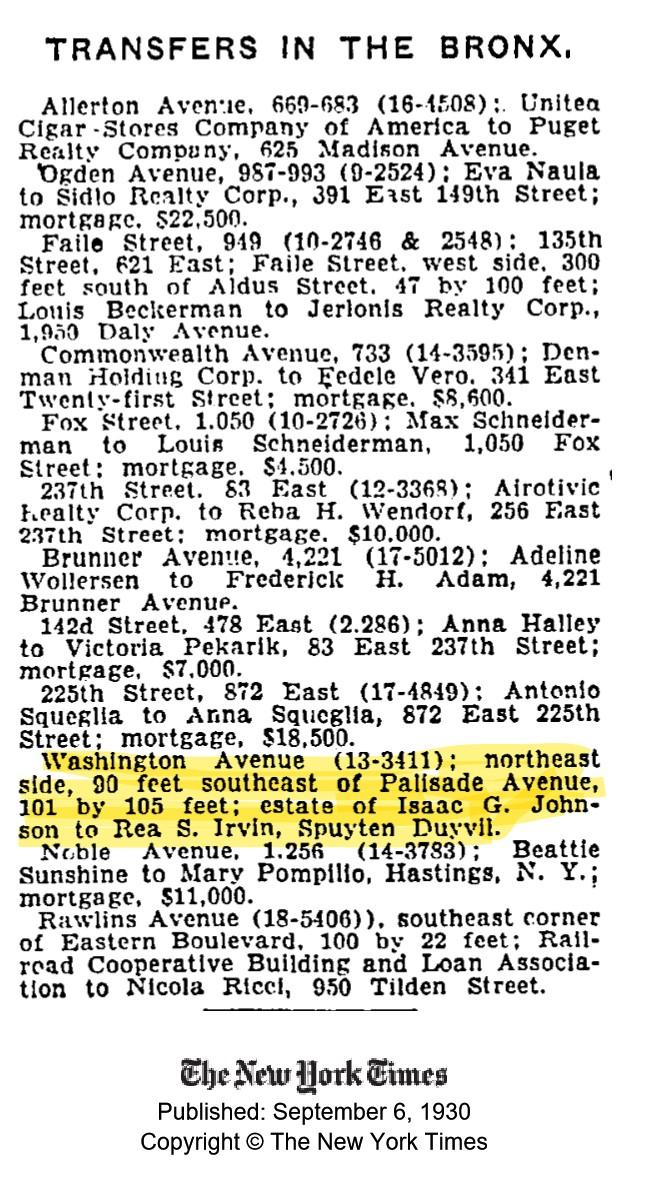
This is what I have found so far. Here is a a blurb from the NY times re a real estate transfer from the Estate of Isaac Johnson to Rea Irvin on September 6, 1930, “southeast of Palisade Avenue”
 June 19, 2025 at 7:34 am in reply to: North Riverdale Man faced Death Penalty for Registering Black Voters in GA, 1963 #4788
Commemorating Juneteenth 2025 by recognizing the contributions of local history to the overall narrative.
 And finally, the signage has been installed in Spuyten Duyvil Shorefront Park, at the south entrance.
I don’t think so Tom. But after extensive pruning of this tree last year (for the first time in memory, of at all), the tree is healthy and brimming with baby apples!
-
AuthorPosts